Punctuation signals
- Use a period [ . ] at the end of a sentence that makes a statement. There is no space between the last letter and the period. Use one space between the period and the first letter of the next sentence. This goes against the grain for people using the typography instilled by generations of old-fashioned typewriter users, but modern word-processors nicely accommodate the spacing after a period, and double-spacing after a period can only serve to discombobulate the good intentions of one's software.
- Example: Dog and cat are friends.
2.Use a question mark [ ? ] at the end of a direct question. It is considered bad form to use a question mark in combination with other marks, although that is often done in informal prose in an attempt to convey complex tones: He told you what!? That combination (or similar combination) of punctuation marks is sometimes called an interrobang, but the interrobang currently has no role in academic prose.
- Example: What time is it?
3. Use an exclamation point [ ! ] at the end of an emphatic declaration, interjection, or command.
"No!" he yelled. "Do it now!"
An exclamation mark may be used to close questions that are meant to convey extreme emotion, as in.
What on earth are you doing! Stop!
An exclamation mark can be inserted within parentheses to emphasize a word within a sentence.
We have some really(!) low-priced rugs on sale this week.
4. Use a comma to separate the elements in a series (three or more things), including the last two. "He hit the ball, dropped the bat, and ran to first base." You may have learned that the comma before the "and" is unnecessary, which is fine if you're in control of things.
Use a comma + a little conjunction (and, but, for, nor, yet, or, so) to connect two independent clauses, as in "He hit the ball well, but he ran toward third base."
5.Use a semicolon [ ; ]
- to help sort out a monster list:
There were citizens from Bangor, Maine; Hartford, Connecticut; Boston, Massachusetts; and Newport, Rhode Island.
OR
We had four professors on our committee: Peter Wursthorn, Professor of Mathematics; Ronald Pepin, Professor of English; Cynthia Greenblatt, Professor of Education; and Nada Light, Professor of Nursing. - to separate closely related independent clauses:
My grandmother seldom goes to bed this early; she's afraid she'll miss out on something.

Capitalization
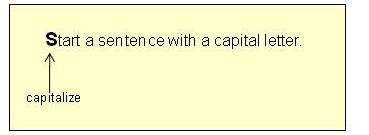
- the first word of a sentence
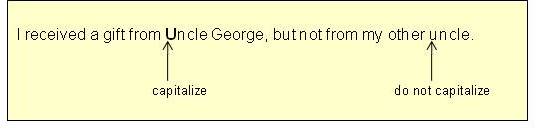
- proper nouns: names of relatives (to indicate family relationship) when used with name
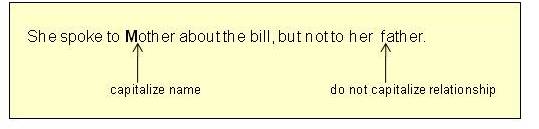
- names of relatives when used as proper name
- If there is any doubt about the Capitalization enter this link:
- http://study.com/academy/lesson/capitalization-rules-in-writing.html
